
Top Trucks and SUVs for Confident Pulling
Planning to tow a camper with a used vehicle starts with the right match between your trailer and your tow rig. This guide breaks down towing terms, the features that matter, and standout used models that balance capability, comfort, and value. From midsize pickups and full size trucks to body on frame SUVs, we highlight options for lightweight teardrops, family travel trailers, toy haulers, and fifth wheels. You can browse current options in our used inventory, compare model families on our research page template, and dig deeper on related topics like best used vehicles for towing and best used trucks for towing campers. Whether you prioritize maximum tow ratings, stable handling, or long term reliability, use the insights below to build a short list and prepare for a safe, stress free camping season.
Every camper and tow vehicle combination is different. Before you decide, confirm the exact tow rating, payload, axle ratio, and equipment on any vehicle you consider. For ownership details and budgeting information, see payment options. To compare vehicles in person, visit schedule a test drive. If you are moving from another tow vehicle, check value my trade. For hitches, brake controllers, and service, see schedule service.
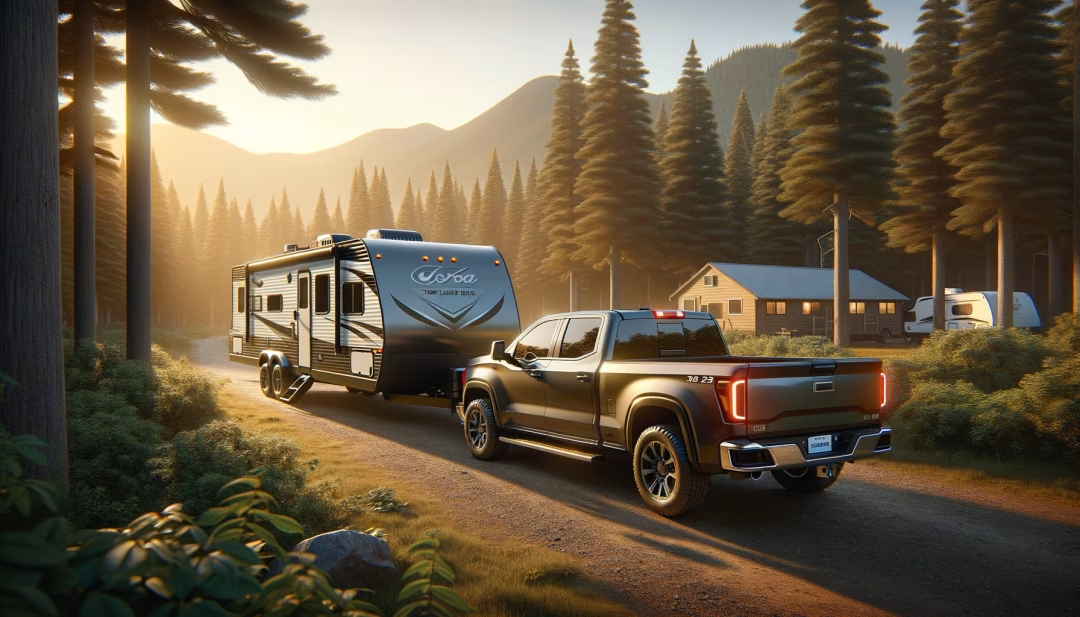
What to know before you tow
Matching a used vehicle to a camper is more than a single tow rating. Real world safety depends on payload, tongue weight, cooling, gearing, brakes, and stability aids. Start with the driver door jamb stickers and the owner manual for any candidate vehicle, and get the true weight of your trailer as loaded for a trip. The terms below will help you interpret ratings and avoid overload.
- GVWR: Maximum the vehicle can weigh when loaded with fuel, passengers, cargo, and tongue weight.
- GCWR: Maximum combined weight of vehicle plus trailer, loaded as used.
- Payload: Weight the vehicle can carry in the cabin and bed. Tongue weight counts against payload.
- Tongue weight: Downforce on the hitch. Typical travel trailers run 10 to 15 percent of actual trailer weight. Fifth wheels often run 15 to 25 percent.
- Axle ratio: A higher numerical ratio can boost tow rating and help with hill climbing, at the expense of some fuel economy.
- Tow package: Often adds a hitch, 7 pin wiring, trailer brake controller, transmission cooler, larger radiator, alternator, and different gears.
Match the vehicle to your camper
Different trailer types place different demands on your tow vehicle. Consider the actual loaded weight, the shape of the camper, and the roads you travel. Aerodynamic drag can stress a powertrain even when weight seems moderate, especially at highway speeds or through mountain passes.
- Teardrops and pop ups, often 1,000 to 2,500 pounds: Suitable for many V6 crossovers with factory tow packages and most midsize pickups.
- Lightweight travel trailers, about 3,000 to 6,000 pounds: Best with midsize pickups near max tow or full size half ton trucks and stronger midsize or full size SUVs.
- Family travel trailers, about 6,000 to 9,000 pounds: Comfort zone for properly equipped half ton trucks and full size body on frame SUVs; heavy floorplans may need 3/4 ton trucks.
- Toy haulers and large trailers, 7,500 to 12,000 plus: Often require heavy duty 3/4 ton or 1 ton trucks, especially in hilly terrain.
- Fifth wheels and goosenecks: Typically need 3/4 ton or 1 ton trucks due to higher pin weight that hits payload hard.
Best used trucks for camper towing
Truck capability varies widely by engine, axle ratio, cab, bed length, 2WD vs 4WD, and whether the factory tow package is installed. Always verify the individual truck sticker and manual. The ranges below are common ballparks and can vary by model year and configuration.
Midsize pickups for lighter campers
Midsize trucks deliver maneuverability for city parking and forest roads, with enough power for small to medium travel trailers. Look for factory tow packages and integrated controllers where available.
- Toyota Tacoma V6: Often 6,400 to 6,800 pounds when properly equipped. Durable drivetrains and strong aftermarket support. Best for aerodynamic trailers under 5,000 pounds as loaded.
- Chevrolet Colorado and GMC Canyon V6 or 2.8L Duramax diesel: Commonly 7,000 to 7,700 pounds with solid torque. The diesel excels at steady highway towing and mountain climbs.
- Ford Ranger 2.3L EcoBoost: Often rated up to 7,500 pounds with tow package. Strong midrange torque, efficient when unhitched.
Half ton pickups for most travel trailers
Half ton trucks balance daily comfort with stout tow ratings. They are a sweet spot for many family travel trailers, especially with V8 or turbocharged V6 engines and the right gears.
- Ford F 150: 5.0L V8 and 3.5L EcoBoost models with max tow packages often span about 9,000 to 13,000 pounds. Features like Pro Trailer Backup Assist and integrated brake controllers add confidence.
- Ram 1500: 5.7L HEMI and eTorque variants commonly tow 8,000 to over 12,000 pounds when equipped right. Coil spring or air suspension helps ride quality and leveling.
- Chevrolet Silverado 1500 and GMC Sierra 1500: 5.3L and 6.2L V8 trucks often rate 9,300 to 12,000 plus. Look for the Z82 trailering package and cooling upgrades.
- Toyota Tundra: Many years rate near 9,000 to 10,200 pounds. Renowned durability, straightforward maintenance, and strong aftermarket for towing aids.
- Nissan Titan: Commonly around 9,000 plus with the 5.6L V8. Pro 4X trims add off road hardware that can help with dispersed camping sites.
Heavy duty pickups for big loads and fifth wheels
For large, heavy, or high profile trailers, 3/4 ton and 1 ton trucks bring stronger frames, axles, brakes, and cooling. They are the safer fit when pin weight or tongue weight strains half ton payload.
- Ford F 250 and F 350: Gas V8 and Power Stroke diesel options. Towing commonly spans 12,000 to well over 20,000 pounds when configured for fifth wheel or gooseneck duty.
- Ram 2500 and 3500: HEMI gas and Cummins diesel engines. Excellent exhaust braking on diesel models for mountain descents with large campers.
- Chevrolet Silverado 2500 and 3500 and GMC Sierra 2500 and 3500: Strong gas and Duramax diesel pairings. Pay attention to rear axle ratings and bed length for fifth wheel clearance.
Best used SUVs for camper towing
SUVs work well for families that want three rows, enclosed cargo, and a comfortable ride while still towing a moderate to heavy travel trailer. Body on frame models generally tow more than crossovers, but several unibody SUVs handle small trailers well with the right equipment.
Full size body on frame SUVs
- Chevrolet Tahoe and Suburban, GMC Yukon and Yukon XL: Often 7,500 to 8,500 plus with the Max Trailering Package. Long wheelbase variants improve stability with longer trailers.
- Ford Expedition: Commonly 9,000 plus when properly equipped. Turbo V6 torque and available heavy duty tow packages suit family travel trailers.
- Nissan Armada and Toyota Sequoia: Typically 7,400 to 8,500 plus. Stout V8 power, robust frames, and proven reliability histories.
Capable midsize SUVs
- Toyota 4Runner: Around 5,000 pounds with factory tow prep. Great off pavement stability for smaller trailers.
- Dodge Durango V8: Often 7,200 to 8,700 pounds depending on engine and package. Confident highway manners and robust cooling in tow packages.
- Jeep Grand Cherokee: V6 trims about 6,200, V8 and diesel options 7,200 plus when properly equipped.
Crossovers for small trailers
Unibody crossovers focus on comfort and fuel economy, and several tow small campers well when optioned with tow packages. Keep trailer frontal area and tongue weight conservative.
- Honda Pilot, Kia Telluride, Hyundai Palisade, Volkswagen Atlas: Often 5,000 pounds with the correct package, suitable for small bunkhouse or aerodynamic single axle trailers.
Must have towing features to prioritize
The right features make towing safer and less fatiguing. When comparing used vehicles, confirm these items are present or budget for installation where possible.
- Integrated trailer brake controller and 7 pin wiring for electric brakes and charge line support.
- Transmission cooler and heavy duty radiator for temperature control on grades and in heat.
- Appropriate axle ratio to keep the engine in its torque band on hills and at highway speed.
- Tow or haul mode programming for smarter shift points and engine braking with trailers.
- Trailer sway control, blind spot monitoring with trailer coverage, and available surround view or backup camera with hitch line.
- Leveling aids such as air suspension or a properly sized weight distribution hitch to restore front axle weight.
Used tow vehicle inspection checklist
A careful inspection helps you avoid surprises and budget for maintenance before the first trip. Service records are extremely valuable on vehicles that have towed regularly.
- Transmission: Check fluid color and smell, service history, and shift quality under load during a long test drive.
- Cooling system: Inspect for leaks, recent coolant service, radiator and fan function, and debris blocking airflow.
- Brakes: Measure rotor thickness, verify pad life, and ensure no pulling or vibration in hard stops from highway speed.
- Driveline and gears: Confirm axle ratio from the door sticker or build sheet. Inspect differential and transfer case fluids on 4x4 models.
- Frame and hitch: Look for rust near rear frame rails, quality of hitch installation, and wiring integrity for 7 pin connectors.
- Tires and suspension: Verify load ratings, even wear, and shock condition. Upgraded load range tires can stabilize heavy loads.
Estimate your real world towing capacity
Published tow ratings are a starting point. Your true safe capacity depends on how you load people, pets, gear, fuel, and the hitch. A simple calculation can keep you within limits.
- Find payload on the door jamb sticker. Subtract the combined weight of passengers, accessories, and cargo you plan to carry in the vehicle.
- Estimate tongue weight as 10 to 15 percent of your actual trailer weight for most travel trailers. Use the higher end for stability.
- Ensure remaining payload is greater than expected tongue weight. If not, move up in vehicle class or downsize the trailer.
- Confirm that combined truck and trailer weight does not exceed GCWR, and that axle ratings are respected when loaded and hitched.
Example pairings
Use these scenarios as a quick filter. Always verify your exact weights and ratings on the specific vehicle and trailer you plan to combine.
- 3,000 to 3,500 pound aerodynamic trailer: V6 SUV with 5,000 pound tow rating or a midsize pickup with tow package. Consider a weight distribution hitch if tongue weight nears payload limits.
- 5,000 to 6,000 pound 23 to 25 foot trailer: Half ton pickup with V8 or turbo V6 and 3.55 to 3.73 gears. Long wheelbase improves stability in crosswinds.
- 7,500 to 9,000 pound family bunkhouse: Half ton with max tow and robust payload or step to a 3/4 ton for extra margin and cooler running temps in the mountains.
- 10,000 to 14,000 pound fifth wheel: 3/4 ton or 1 ton truck with sufficient payload for pin weight, long bed recommended for turning clearance.
Related resources and research
Keep exploring to fine tune your plan and compare top models for towing, camping, and family travel.
- best used suvs for camping for trail ready family haulers.
- best used vehicles for boat towing if you split time between ramps and campsites.
- used car inspection checklist to evaluate your tow rig like a pro.
- how to buy a used car and how to finance a used car for process clarity.
- Compare options across segments in our best used trucks under 20000 and best used awd vehicles guides.
Frequently asked questions about used vehicles for camper towing
Plan the next step
When you are ready to compare candidates, review current options in our used inventory, scan recent ownership insights on the blog, and meet the team on meet our staff. For store details, see locations. For policy information, see privacy policy, terms, and visitor agreement. If you want to see prior models we have carried, visit sold inventory.
Office Hours
Monday
Tuesday
Wednesday
Thursday
Friday
Saturday
9:00 am - 5:00 pm
9:00 am - 5:00 pm
9:00 am - 5:00 pm
9:00 am - 5:00 pm
9:00 am - 5:00 pm
Closed
